
Sub-synchronous oscillations are a known and manageable feature of power systems. In power systems with very high shares of inverter-based resources (IBRs), interactions between the IBR controls and the grid can exacerbate grid stability risks such as poorly damped sub-synchronous oscillations (SSO). Mitigating SSO without limiting IBRs on the grid requires new methods and tools.
Researchers at the EPICS Global Centre at Imperial College London are developing a holistic framework to help system operators foresee and mitigate the risk of widespread IBR-induced SSO.
Foreseeing and mitigating risk of IBR-induced SSO
Poorly damped sub-synchronous oscillations (SSO) have emerged as a major challenge in power grids with high shares of inverter-based resources (IBRs). These oscillations often arise from adverse interactions between IBR controls and the grid and are difficult to analyse and foresee due to lack of transparency of vendor-specific IBR models.
We adopt a holistic and systematic approach to foresee and mitigate the risk of widespread IBR-induced SSO (henceforth referred to as SSO for brevity). This spans planning, operation, post-event analysis and IBR control design – all enabled by a frequency-domain digital twin (DT) and PMU/WMU data. Planning measures include: (1) capturing risk of SSO during connection compliance process itself and (2) rapid scenario screening for SSO risk in operational planning. In operation we cover: (1) early warning of incipient SSO near real-time and (2) SSO root cause analysis in real-time using live streamed PMU/WMU data. Following an SSO event, we focus on a systematic post-event analysis based on recorded PMU/WMU data to pinpoint the top SSO contributor(s). Finally, we work on IBR control design factoring in the tightened compliance requirements and post-event analysis for effective prevention and mitigation of SSO. The overall mitigation framework is summarised below.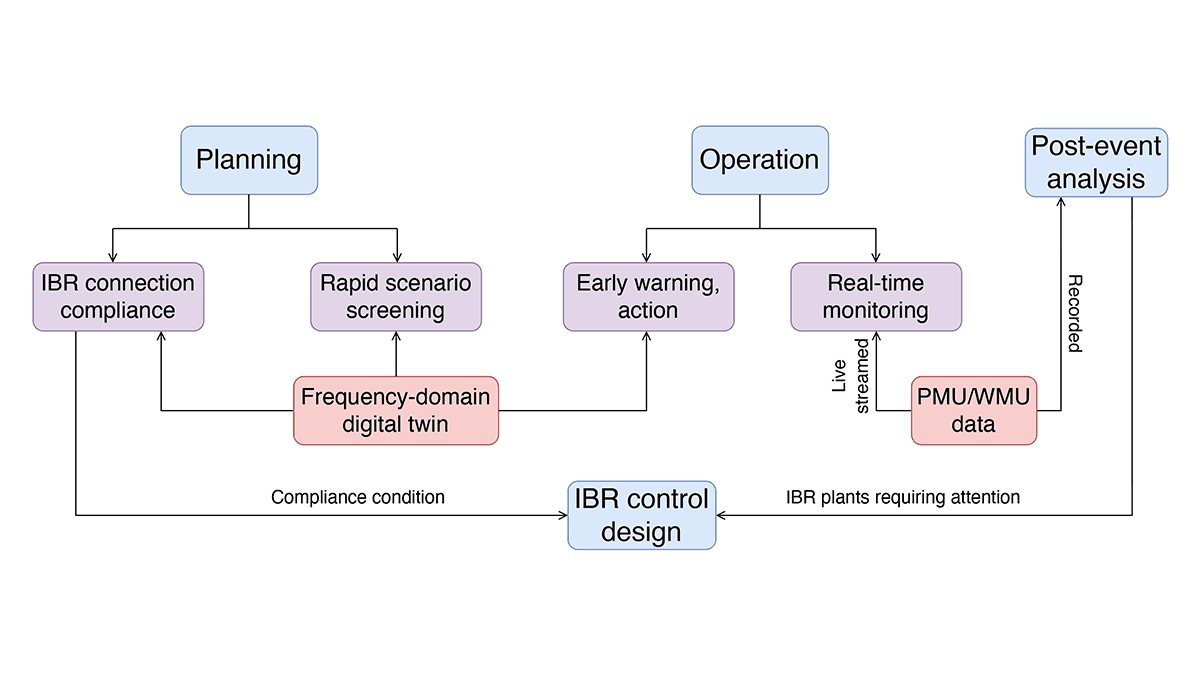
1. Frequency-domain digital twin
Wide-area EMT simulation (if the system operator has the capability) can support planning but is computationally expensive, difficult to run across many operating conditions and provides limited insight into the mechanisms driving SSO for mitigation. Moreover, selecting where to apply a disturbance in a wide-area EMT model is non-trivial without prior knowledge of where critical modes can be adequately excited. A frequency-domain digital twin (DT) offers a faster and more insightful alternative and enables early warning, rapid scenario screening and connection compliance by tracking overall system dynamics as operating point vary.
We develop a bottom-up modular DT in EMT-dq framework [1] that obviates the need for repeated system-level scans on a wide-area EMT model from multiple locations as operating point evolves. The DT requires each IBR plant to be represented by a library of estimated frequency responses [2, 3] spanning its entire operating range. This library is generated offline and can be mandated as part of the IBR connection process. The frequency response of each IBR plant at any target operating point can then be accurately obtained through interpolation over coherent operating regions [4]. Combined with passive network and other known component models, the DT continuously tracks system dynamics, enabling early detection of incipient SSO and dominant contributors [5]. In planning, the DT provides an efficient route to IBR connection compliance and rapid scenario screening.
2. IBR connection compliance
The current IBR connection compliance process is inadequate to capture SSO risk because it typically employs simplified network equivalents and assesses each connecting IBR plant independently. We address this through decentralised stability conditions based on block diagonal dominance (BDD) that are locally verifiable for multiple IBRs connecting at different locations [6]. Use of BDD already reduces conservativeness significantly, and our ongoing work focuses on reducing it further. Using the impedance/admittance transfer function of the grid (including existing IBRs) at locations where IBR plants are connecting, compliance can be assessed over a subset of operating points while guaranteeing stability and minimum damping across the full operating range.
3. Rapid scenario screening for SSO risk
The DT enables rapid screening of SSO risk in frequency domain for a large number of scenarios (operating points). We use spatiotemporal characterisation to obtain the SSO frequency and damping, its root cause and geographical spread across the network [7] that can provide system operators with actionable insight rather than simply risk flags. A voltage-stiffness-based system strength index is used as a simple yet reliable proxy of SSO risk. This can be calculated from frequency response at different locations readily obtainable from the DT [8]. The framework is being extended to quantify adverse control interactions among multiple IBRs.
4. Early warning of incipient SSO and action
Once the dispatch is determined, the DT assesses prevailing operating point for incipient SSO risk. The same spatiotemporal analysis (as in scenario analysis) identifies the root cause and geographical spread, while the system strength metric highlights weak areas where relevant system services need to be procured. Targeted mitigation actions are obtained by solving an optimisation problem that minimally adjusts selected IBR set-points (P, Q or V) to ensure adequate damping of SSO for the prevailing dispatch condition.
5. Real-time SSO monitoring
We are developing a recursive extended dynamic mode decomposition (EDMD), grounded in Koopman operator theory, to estimate SSO damping and frequency and top contributors directly from live-streamed PMU/WMU data. Ongoing work is addressing reliable detection of stage transition and adaptive parameter updating with changing conditions.
6. Post-event analysis
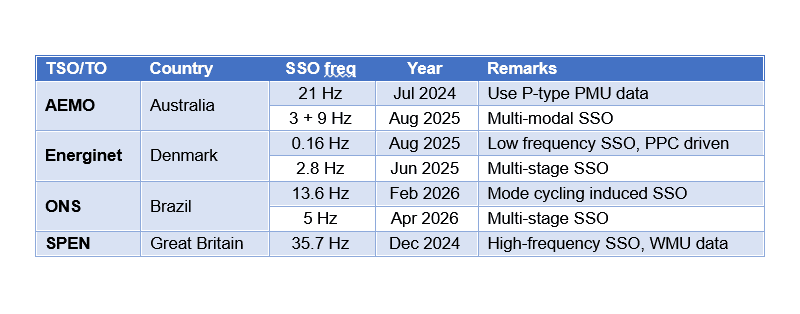
After an SSO event has occurred, we use batch EDMD to identify top SSO contributors from recorded PMU/WMU data. Relative contribution of each PMU/WMU location in critical SSO mode(s) is calculated from the estimated reduced Koopman-like operator. This method has been validated using real SSO event data from Australia [9], Denmark [10], Brazil and Great Britain as summarised below [11].
7. IBR control design
IBR vendors/developers may need to redesign/retune their IBR controls to satisfy updated connection compliance condition. We have developed a decentralised control design framework that exploits higher degrees of freedom [12] to meet the block diagonal dominance compliance condition [13]. For grid-forming (GFM), trajectory optimisation (underpinning method in [14]) is used to co-optimise software and hardware design and maximise available headroom for service provision while satisfying the time-domain compliance criteria.
Research team
Ambuj Gupta, Debraj Bhattacharjee, Gabriel Covarrubias Maureira, Jia Lu, Jianli Gao, Pudong Ge, Sharjeel Javaid, Tomas Ochoa, Xiaoyu Tan, Youhong Chen, David Angeli, Janusz Bialek, Mark O’Malley and Balarko Chaudhuri. Contact: b.chaudhuri@imperial.ac.uk
Acknowledgement
This research is supported by UKRI through EPICS global centre and National Energy System Operator (NESO) in Great Britain through innovation projects on Digital-twin based Stability Analysis Tool and Enhanced Connection Compliance and Post-event Analysis and driven by the G-PST research agenda
References
[1] M. S. Javaid, B. Chaudhuri, F. Teng, and Z. Akhtar, “EMT-RMS Modeling Trade-Off for IBR-Driven Sub-Synchronous Oscillations,” IEEE Transactions on Power Systems, vol. 41, no. 1, pp. 425-437, 2026, doi: 10.1109/TPWRS.2025.3588893.
[2] D. Bhattacharjee, M. S. Javaid, A. Gupta, J. Gao, and B. Chaudhuri, “Moment-Based Estimation of IBR-Dominated Power Systems: Theory and Applications,” IEEE Transactions on Power Systems, 2026. Under review, copy available on request.
[3] J. Gao, M. S. Javaid, D. Bhattacharjee, Y. Chen, and B. Chaudhuri, “In Situ Estimation of IBR Models for Analyzing Sub-Synchronous Oscillations,” IEEE Transactions on Power Systems, in Early Access, 2026, doi: 10.1109/TPWRS.2026.3683844.
[4] G. Covarrubias Maureira, B. Chaudhuri, and M. O’Malley, “Parameterizing Operating-Point-Dependent IBR Using Coherent Operating Regions for Sub-synchronous Oscillation Analysis,” arXiv preprint, Preprint 2026. [Online]. Available: https://arxiv.org/abs/2607.00216.
[5] G. Covarrubias Maureira, M. S. Javaid, B. Chaudhuri, M. O’Malley, D. Anaya, I. Dytham, J. Ramachandran, and X. Zhou, “A Digital Twin for Early Warning of IBR-Induced Oscillations,” to be presented at the 25th Wind & Solar Integration Workshop, Porto, Portugal, 2026.
[6] Y. Chen, X. Tan, M. S. Javaid, D. Angeli, and B. Chaudhuri, “Decentralized Stability of IBR-dominated Power Grids Using Block Diagonal Dominance,” arXiv preprint, Preprint 2026. [Online]. Available: https://arxiv.org/abs/2606.28023.
[7] M. S. Javaid, G. Covarrubias Maureira, A. Gupta, D. Bhattacharjee, J. Gao, B. Chaudhuri, and M. O’Malley, “Spatial Characterization of Sub-Synchronous Oscillations Using Black-Box IBR Models,” presented at the IEEE PES General Meeting, Montreal, Canada, 2026, Preprint. [Online]. Available: https://arxiv.org/abs/2603.15399.
[8] A. Gupta, B. Chaudhuri, and M. O’Malley, “Jacobian Voltage Stiffness Metric — A Measure of Grid-Forming Capability and System Strength in IBR-Dominated Grids,” arXiv preprint, Preprint 2026. [Online]. Available: https://arxiv.org/abs/2607.09249.
[9] J. Lu, Y. Chen, D. Bhattacharjee, B. Chaudhuri, M. O’Malley, M. Binet, C. Linden, N. Qin, and A. P. Expethit, “Pinpointing Root Cause of Oscillations: Case Studies with Real Oscillation Events in Australia and Denmark,” to be presented at the 25 th Wind & Solar Integration Workshop, Porto, Portugal, 2026.
[10] Y. Chen, D. Bhattacharjee, B. Chaudhuri, M. O’Malley, N. Qin, and A. P. Expethit, “Data-Driven Post-Event Analysis with Real-World Oscillation Data from Denmark,” presented at the IEEE PES General Meeting, Montreal, Canada, 2026, Preprint. [Online]. Available: https://arxiv.org/abs/2511.20939.
[11] Y. Chen, J. Lu, D. Bhattacharjee, B. Chaudhuri, M. O’Malley, A. Felipe, B. Pestana Rosa, C. Henderson, C. Linden, D. Filho, M. Binet, and N. Qin, “Post-Event Analysis of IBR-induced SSO Using Real PMU/WMU Data from Four TSOs/TOs,” IEEE Transactions on Power Systems, 2026. Under review, copy available on request.
[12] P. Ge, M. S. Javaid, B. Chaudhuri, and J. Bialek, “Robust MIMO Control of Inverter-Based Resources for Enhanced Performance and Grid Stability,” IEEE Transactions on Power Systems, 2026. Under review, copy available on request.
[13] P. Ge, M. S. Javaid, X. Tan, J. Gao, D. Angeli, J. Bialek, and B. Chaudhuri, “Decentralized Control Synthesis in IBR-Dominated Power Systems: A Block Diagonal Dominance Based Approach,” arXiv preprint, Preprint 2026. [Online]. Available: https://arxiv.org/abs/2608.01236
[14] T. Ochoa, B. Chaudhuri, and M. O’Malley, “Optimal Control for Robust Dynamic Performance in Inverter-Dominated Power Systems,” IEEE Transactions on Power Systems, in Early Access, 2026, doi: 10.1109/TPWRS.2026.3701870.