
Under this year’s motto “Ensuring Grid Stability for Tomorrow”, the 50Hertz Global Summit brought together system operators, researchers, and industry experts from around the world on . GPST and the Energy Systems Integration Group (ESIG) co-hosted a track titled “Ensuring Stability in Real-Time Operations under High IBR Penetration”.
17 September 2026: Control Room of the Future
The first day looked at what operators need in the control room of the future. The opening session on situational awareness covered what they must observe in real time, including essential metrics, system strength, inertia awareness, state estimation and real-time simulations, with operator perspectives from ERCOT (Texas, USA), ONS (Brazil), and NESO (Great Britain). During the second session, Imperial College London, NLR, TenneT (Germany, Netherlands), and Fraunhofer IEE discussed how Wide Area Monitoring, Protection, and Control (WAMPAC) applications, dynamic event detection and early-warning tools for sub-synchronous oscillations support real-time operational decisions. Imperial presented a bottom-up modular approach to track the evolving operating point-dependent dynamics of IBR-dominated grids, which would enable early warning of incipient sub-synchronous oscillations (SSO) and targeted mitigation action. The day closed with a session on innovations in decision support, covering visualization, alarm prioritization, integration of Energy Management Systems (EMS) and Wide Area Monitoring Systems (WAMS) and human-centered interfaces, with a special focus on emerging AI applications. Speakers from operators 50Hertz (Germany), CEN (Chile), ONS and ERCOT shared experiences and lessons learned.
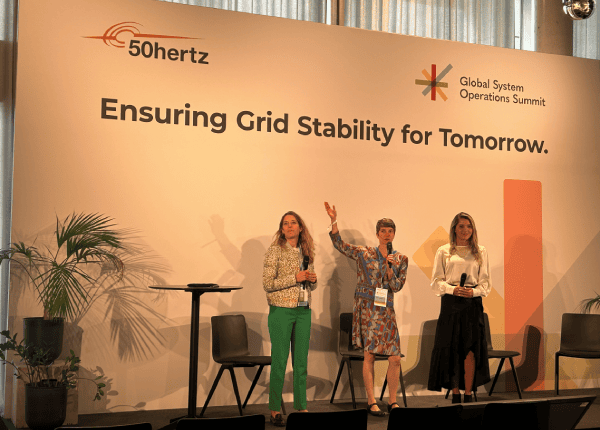
Karin Wadsack and Lina Ramirez from GPST, as well as Sabine Oberhausen from 50Hertz opened the GPST/ESIG track during the 50Hertz Summit.
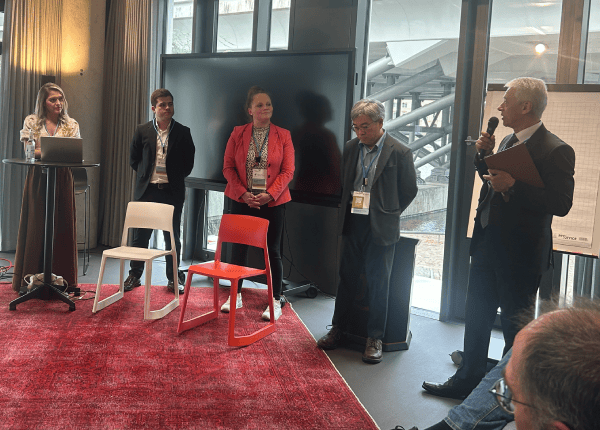
Speakers from 50Hertz, CEN, ONS, and ERCOT exchanged experiences on decision support in the Control Room of the Future.
18 September 2026: Grid-Forming Technologies
The second day turned to system strength and grid-forming technology. An ESIG-led session presented emerging classifications and frameworks, new metrics and methods for evaluating system strength, and applied examples from Imperial, Telos Energy and MISO (USA, Canada). A session co-convened by GPST’s GFM Council and ESIG’s Reliability Working Group shared practical lessons from early grid-forming deployments with experiences from ESIG, TenneT, Siemens, NESO, and Zenobē. The track concluded with a System Operator Roundtable, where nine operators from across the conference exchanged lessons learned and successful approaches to identifying, assessing and mitigating SSOs, and discussed how to collaborate on future solutions.
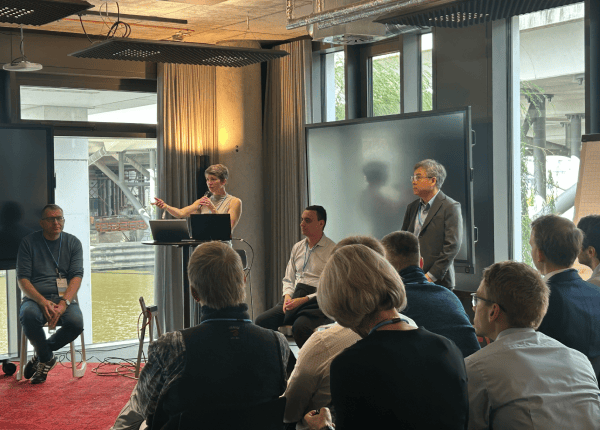
NESO, ONS, and ERCOT discussed real-time stability indicators, the level of observability required and current operator.
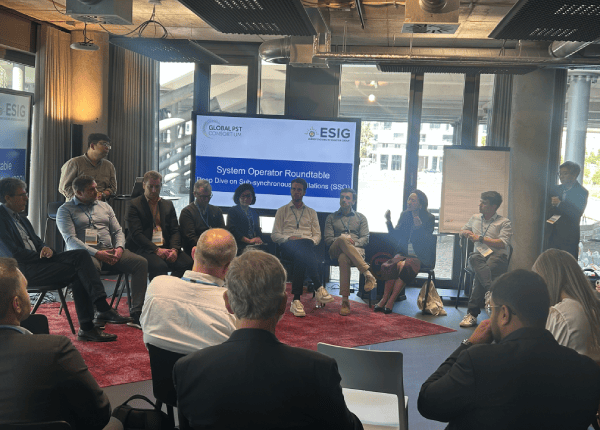
Operators from across the world exchanged experiences during the System Operator Roundtable.
The track showed how closely operational practice, new monitoring tools and emerging grid-forming experience are now linked. GPST will continue to bring these communities together.
Find the full Summit agenda here. Access available slide decks on ESIG’s website.